Loading smiles...

The Canadian Dental Association recommends a baby’s first dental assessment within six months of the first tooth erupting or by one year of age.
That first visit is usually much more about getting to know your baby’s growing smile, answering questions, and helping your family build healthy habits than it is about treatment.
When Should My Baby First See a Dentist?
When you see the first tooth — and no later than the first birthday — is a good rule of thumb.
More precisely, the Canadian Dental Association recommends an assessment within six months of the first tooth erupting or by one year of age. You do not have to wait until your child has a mouth full of teeth. Even one little tooth is enough to start the conversation.
Because it’s better to prevent a dental problem than to treat it!
You may already be wondering about teething, brushing, toothpaste, bottles and cups, feeding habits, or a little spot you have noticed on a tooth. An early visit gives you somewhere to bring those questions while your baby’s smile is just getting started.
The Canadian Dental Association recommends an early assessment so a dentist can look at cavity risk, discuss prevention with parents and caregivers, and help establish ongoing dental care before problems develop.
It also gives our team a first look at how your baby’s mouth and teeth are developing.
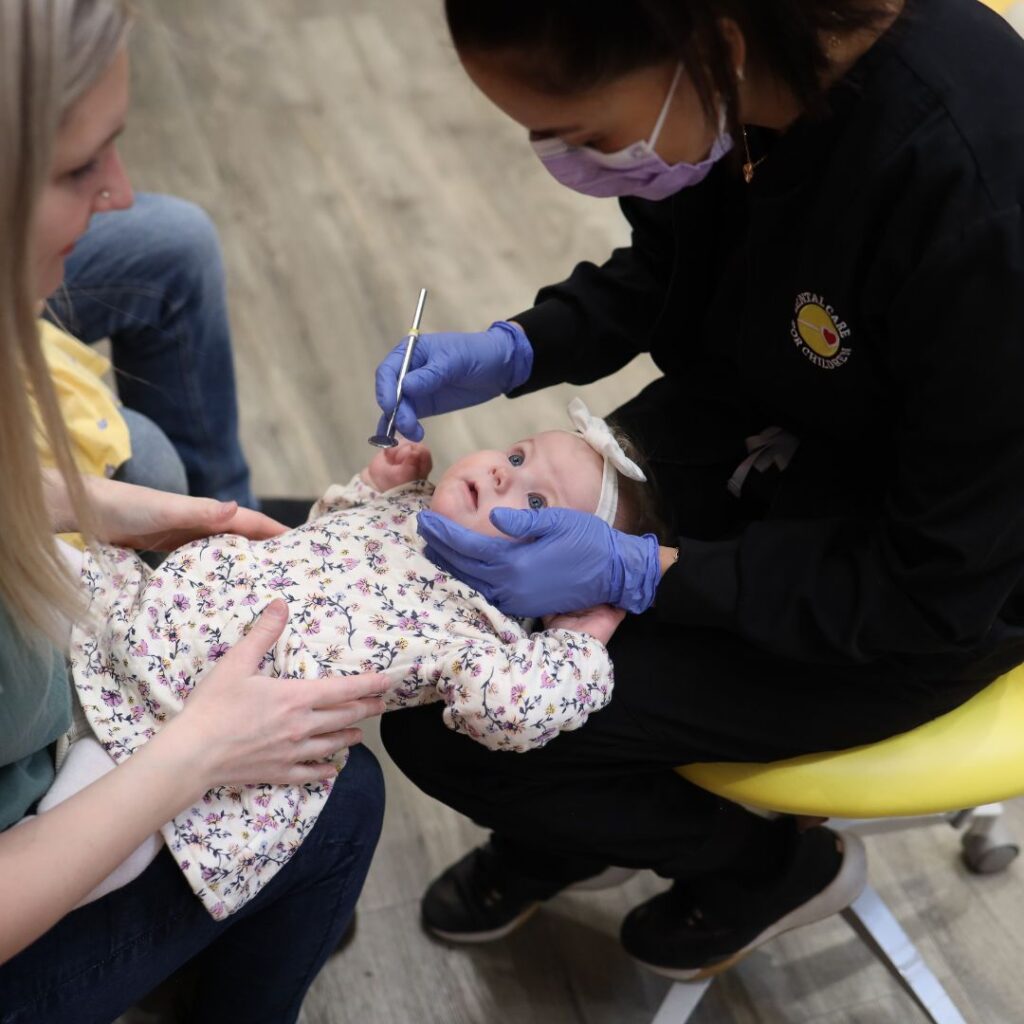
Every first visit is adapted to your child’s age, stage, and comfort level. Depending on your baby’s needs and what our Pediatric Dentists see, the appointment may include:
For many families, one of the most useful parts of the appointment is simply having a place to ask questions and know what to expect next.
Babies have their own ideas about appointments.
Some are curious. Some would much rather stay close to their parent or caregiver. Some are simply not interested in opening their mouth when we ask — and we can work with that.
We follow your baby’s age and stage, keep the visit gentle, and learn what we can without expecting every first appointment to look the same. You will be surprised by our tricks and techniques to get your child to allow us to take a look. You might even learn a little something to try at home.
Those first little teeth need care as soon as they arrive.
For children under 3, the Canadian Dental Association recommends talking with a health professional about your child’s risk of tooth decay when deciding how fluoridated toothpaste should be used.
If a young child is considered at risk, CDA guidance recommends that an adult brushes with a grain-of-rice-sized amount of fluoridated toothpaste. For children ages 3 to 6, the CDA recommends brushing with a pea-sized amount of fluoridated toothpaste with adult assistance.
We can help you understand what is appropriate for your child and turn the guidance into a simple routine at home.
There is no single schedule for every child.
The Canadian Dental Association notes that, in most cases, dental exams about every six months allow the dentist to identify small problems early, while the right schedule still depends on the individual child’s needs.
We’ll let you know when we’d like to see your child again — and why.
A dental home simply means your child has an ongoing relationship with a dental team that knows them and can care for their smile as they grow.
It gives your family a familiar place for Preventive Care, questions, dental problems, emergencies, and all the changes that happen from those first little teeth onward.
For us, the goal is to build that relationship early — so the dentist can become a familiar part of caring for your child’s health, not somewhere you only visit when something is wrong.
Your child’s first dental visit sets the tone for a lifetime of healthy habits. ✨
That’s why we make every early experience positive, gentle, and full of encouragement. Our goal isn’t just healthy teeth — it’s a child who leaves our office feeling proud. Proud of their smile. Proud of their bravery. Proud of themselves.